
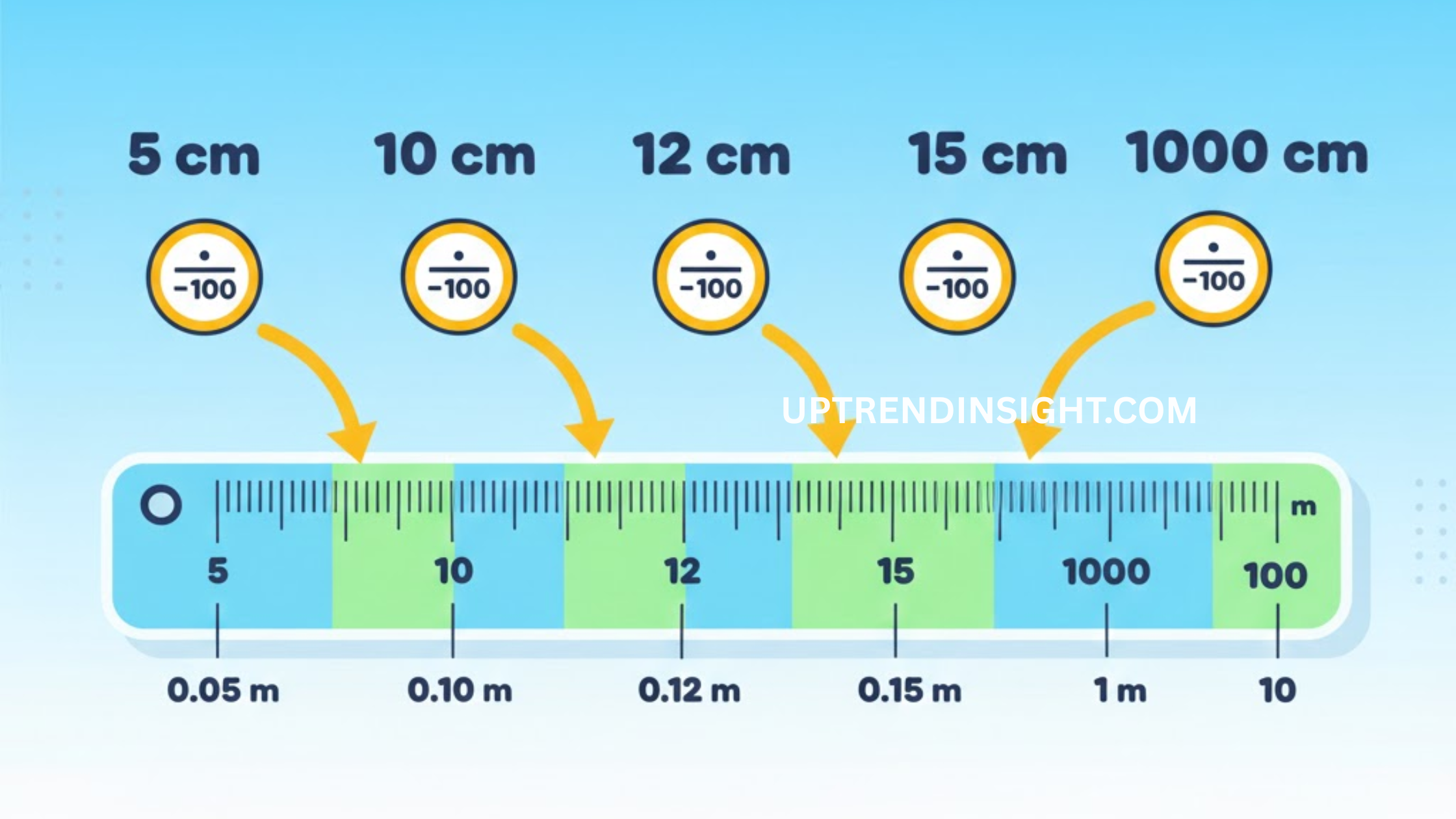
Introduction to Cm to M Conversion
Understanding measurements is a vital skill in everyday life, science, and education. One of the most common conversions students, professionals, and hobbyists encounter is cm to m — converting centimeters into meters. This guide will walk you through the entire process, explain formulas, provide examples, and give practical tips for accurate measurement.
Why Understanding Cm to M Conversion Matters
Whether you are measuring your height, planning a DIY project, or solving physics problems, understanding the relationship between centimeters and meters simplifies your work. Many beginners often get confused by metric conversions, but once you know the simple rule behind cm to m, it becomes easy to calculate any length accurately.
Centimeters (cm) measure smaller lengths, while meters (m) measure longer distances. 1000 cm is the same as 10 meters. In physics, construction, and daily life, converting between these units ensures precision.
The Cm to M Formula Made Simple
Converting centimeters to meters follows a straightforward formula:
Meters=Centimeters100\text{Meters} = \frac{\text{Centimeters}}{100}Meters=100Centimeters
Why divide by 100? Because 1 meter equals 100 centimeters. This means every 100 cm equals exactly 1 meter.
Example:
- 100 cm ÷ 100 = 1 m
- 12 cm ÷ 100 = 0.12 m
You can use this formula for any measurement, whether it’s 10 cm, 15 cm, or 1000 cm.
Step-by-Step Method to Convert Cm to M
- Identify the measurement in centimeters.
Example: 150 cm - Divide the centimeter value by 100.
Calculation: 150 ÷ 100 - Write the result in meters.
Answer: 1.5 m
This method applies to all your related keywords: 100 cm to m, 12 cm to m, 10 cm to m, 5 cm to m, 15 cm to m, and 1000 cm to m.
Practical Examples Using Common Conversions
Let’s apply the formula in real-life scenarios:
- 100 cm to m
100 ÷ 100 = 1 m
Example: A ruler that measures 100 cm is 1 meter long. - 12 cm to m
12 ÷ 100 = 0.12 m
Example: A small pencil’s length is 12 cm or 0.12 m. - 10 cm to m
10 ÷ 100 = 0.1 m
Example: A notepad may measure 10 cm or 0.1 m. - 5 cm to m
5 ÷ 100 = 0.05 m
Example: A keychain might be 5 cm or 0.05 m long. - 15 cm to m
15 ÷ 100 = 0.15 m
Example: A smartphone’s width may be 15 cm or 0.15 m. - 1000 cm to m
1000 ÷ 100 = 10 m
Example: A large room may be 1000 cm or 10 meters in length.
How to Convert Cm to M in Physics
Physics frequently requires accurate conversions from centimeters to meters. Using meters as the standard unit of length in formulas ensures calculations are consistent and reliable. For example:
Problem: A ball travels 250 cm. How far is it in meters?
Solution: 250 ÷ 100 = 2.5 m
When you solve physics equations, always convert cm to m first if the standard unit is meters. This ensures accuracy in velocity, distance, and acceleration calculations.
Quick Reference Table for Common Conversions
| Centimeters (cm) | Meters (m) |
| 5 cm | 0.05 m |
| 10 cm | 0.1 m |
| 12 cm | 0.12 m |
| 15 cm | 0.15 m |
| 50 cm | 0.5 m |
| 100 cm | 1 m |
| 250 cm | 2.5 m |
| 1000 cm | 10 m |
This table saves time and gives a visual guide for quick conversions.
Tips to Convert Cm to M Accurately
- Always use the formula: M = Cm ÷ 100.
- Double-check your calculations to avoid measurement errors.
- Use a calculator for larger numbers to prevent mistakes.
- Remember decimals matter: 12 cm is 0.12 m, not 0.12 cm.
- Practice: Convert everyday objects like books, pencils, or furniture to meters.
Common Mistakes to Avoid
- Forgetting to divide by 100.
- Confusing cm with m in formulas.
- Rounding decimals too early leads to inaccurate results.
- Using cm in physics problems where the SI unit is meters.
Avoiding these errors ensures precision in academics, DIY projects, and professional work.
Why This Conversion Is Useful in Daily Life
- Interior Design: Furniture dimensions are often measured in cm, but room layouts may require measurements in meters.
- Education: Students use meters in physics and chemistry problems.
- DIY Projects: Cutting wood, fabric, or other materials often involves converting cm to m.
- Fitness & Health: Measuring height or distances during training or physical activities.
Interactive Practice Questions
- Convert 25 cm to m
- Answer: 25 ÷ 100 = 0.25 m
- Convert 75 cm to m
- Answer: 75 ÷ 100 = 0.75 m
- Convert 500 cm to m
- Answer: 500 ÷ 100 = 5 m
- Convert 1200 cm to m
- Answer: 1200 ÷ 100 = 12 m
These exercises reinforce the method and build confidence in conversions.
Cm to M in Different Contexts
1. Construction
Builders measure walls, doors, and furniture in cm but often convert to meters for planning layouts. Correct conversions ensure accurate blueprints.
2. Science Experiments
Lab measurements often use small lengths in cm, but physics calculations require lengths in meters to match SI units.
3. Everyday Life
From shopping for curtains to measuring a table, knowing cm-to-m conversions simplifies decision-making.
Visualizing Cm to M Conversion
Think of 100 cm as a complete meter stick.
- Half a meter = 50 cm
- Quarter meter = 25 cm
- Small items like pencils = 10-15 cm
Visualizing conversions makes them easier to understand and remember.
Conclusion: Master CM to M with Ease
Converting cm to m is a simple yet essential skill. By understanding the formula, practicing with examples like 100 cm to m, 12 cm to m, 10 cm to m, 5 cm to m, 15 cm to m, and 1000 cm to m, and applying it in physics and daily life, you can measure accurately every time.
Remember, always divide by 100, keep decimals precise, and practice with everyday objects. With consistent practice, converting cm to m will feel second nature.
Learning these conversions improves accuracy, builds confidence, and makes measurement tasks faster and easier.
Explore More