
A Simple Answer to a Common Kitchen Question
Cooking feels easy when measurements make sense. But one common question often confuses home cooks — how many tablespoons are in a cup? Getting it right matters. Small mistakes can change the taste and texture, whether baking cookies, whipping sauces, or measuring butter. Let’s break it down clearly and simply so your recipes always turn out perfect.
Understanding Cups and Tablespoons
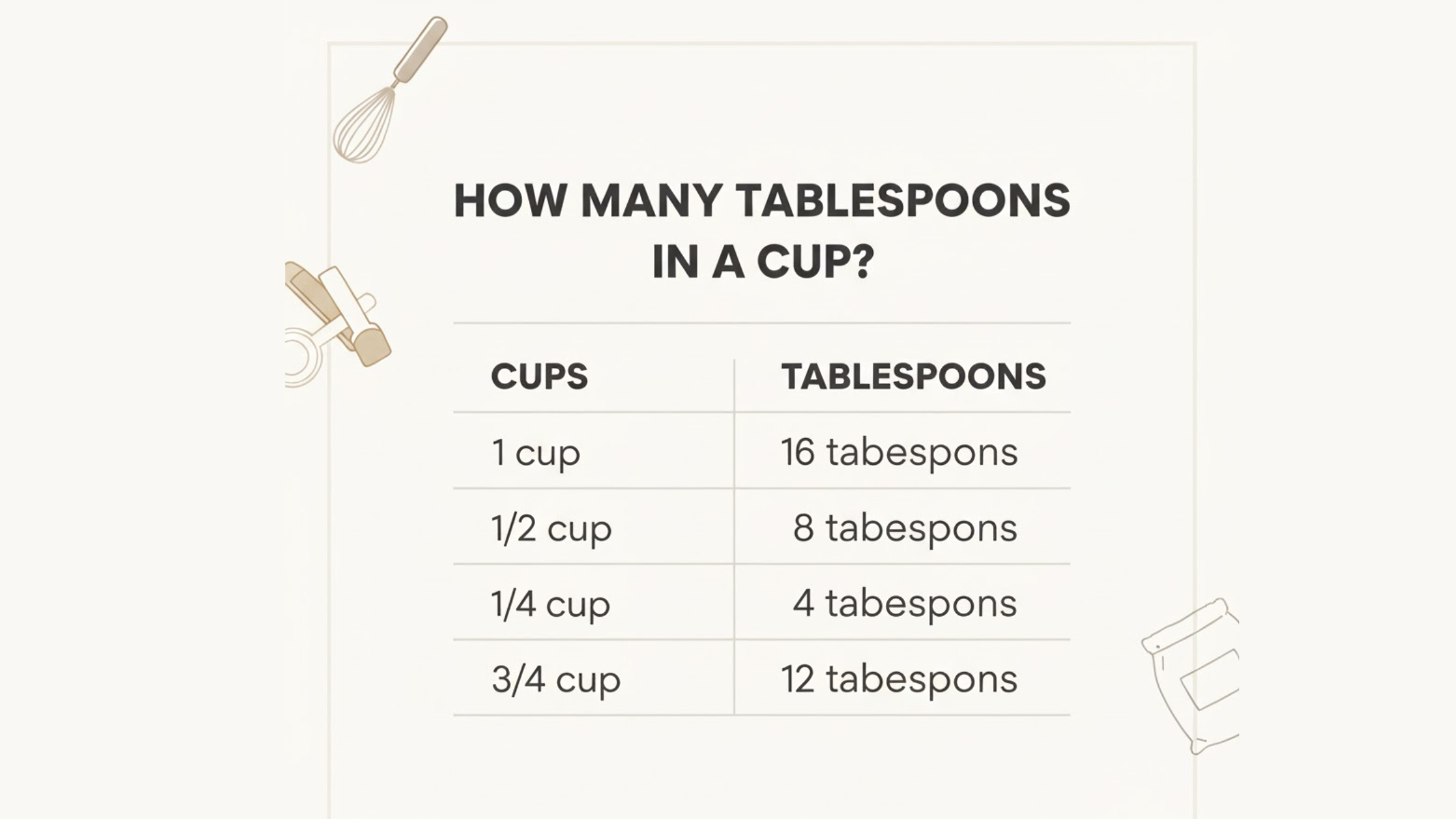
A cup and a tablespoon are both standard kitchen measurement units. The U.S. cup equals 16 tablespoons, a simple, universal conversion used in most American recipes.
So, if a recipe says “1 cup of sugar,” it means 16 tablespoons.
These measurements help you follow recipes without needing a scale. Cups and tablespoons work for dry and liquid ingredients, but measuring each properly is essential.
Why This Conversion Matters
Knowing how many tablespoons are in a cup saves time and balances your dish. Too much flour makes dough heavy; too little butter makes cookies dry. Precision creates consistency.
Professional chefs use exact measurements to maintain flavor and texture. Home cooks should, too. Once you master conversions, you’ll cook confidently — no more guessing or double-checking every recipe online.
How Many Tablespoons in a 1/4 Cup
Let’s start small. If one cup equals 16 tablespoons, then:
1/4 cup = 4 tablespoons.
You’ll often see 1/4 cup in recipes for salad dressings, sauces, and baking. It’s a common portion that’s easy to measure. Use this ratio: every quarter cup equals four tablespoons.
How Many Tablespoons in a 1/3 Cup
Next, for one-third cup, the conversion is:
1/3 cup = 5 tablespoons + 1 teaspoon.
That extra teaspoon makes the measurement exact—precision matters, especially in baking. If you skip that small bit, your batter might become too thick or too thin.
How Many Tablespoons in a 3/4 Cup
If you need three-fourths of a cup, multiply the base number:
3/4 cup = 12 tablespoons.
Many recipes use 3/4 cup for liquids like milk or oil. Always use a liquid measuring cup for wet ingredients and a dry cup for solids.
How Many Tablespoons in 2 Cups
Doubling the base conversion is simple:
2 cups = 32 tablespoons.
This is handy when you scale recipes for prominent families or gatherings. Measuring accurately ensures the taste remains consistent even when you double the ingredients.
How Many Tablespoons in a Cup of Flour
Flour behaves differently from liquids. It packs tightly and can trap air. A cup of flour equals 16 tablespoons, but how you scoop it matters.
Here’s a quick tip:
- Spoon the flour into your measuring cup.
- Level it off with a knife.
This method avoids overpacking and keeps your recipe light and fluffy. Accurate flour measurement is key to making pancakes, bread, or cookies.
How Many Tablespoons in a Cup of Butter
Butter measurements can be confusing, but here’s the clear answer:
1 cup of butter = 16 tablespoons.
If you’re using butter sticks, most U.S. sticks list measurements on the wrapper. One stick equals 8 tablespoons, so two sticks make one full cup.
This conversion is perfect for baking — from brownies to biscuits — where the balance of butter makes or breaks texture.
How Many Tablespoons in a Cup of Oil
Just like other liquids, 1 cup of oil equals 16 tablespoons.
Whether you use olive, vegetable, or coconut oil, the conversion stays the same. Measure carefully, as too much oil can make food greasy, while too little affects flavor and moisture.
How Many Tablespoons in a Cup UK
If you cook with U.K. recipes, the conversion changes slightly. The U.K. tablespoon equals 15 milliliters, while the U.S. tablespoon equals 14.79 milliliters.
A U.K. cup is also larger — about 250 milliliters.
That means 1 U.K. cup = roughly 16.67 U.K. tablespoons.
The difference seems small, but in baking, it can matter. Always check whether your recipe uses U.S. or U.K. measurements to avoid confusion.
How to Measure Ingredients Accurately
Getting conversions right is step one. Measuring correctly is step two. Here’s how:
- Use proper tools: Dry cups are used for solids, and liquid cups are used for liquids.
- Level your ingredients: Use a straight edge to remove excess.
- Avoid packing: Don’t press ingredients down unless the recipe says so.
- Read labels: Some recipes mention grams and cups — double-check before starting.
These simple steps can turn a good recipe into a great one.
Tablespoons to Cups Conversion Chart
| Measurement | Tablespoons | Cups |
| 1 tablespoon | 0.0625 cup | 1 tbsp |
| 2 tablespoons | 0.125 cup | 2 tbsp |
| 4 tablespoons | 0.25 cup | 1/4 cup |
| 8 tablespoons | 0.5 cup | 1/2 cup |
| 12 tablespoons | 0.75 cup | 3/4 cup |
| 16 tablespoons | 1 cup | 1 cup |
| 32 tablespoons | 2 cups | 2 cups |
Keep this chart nearby — it saves time and removes confusion when you’re in the kitchen.
U.S. vs. Metric Systems
In the United States, recipes use cups, tablespoons, and teaspoons. But many countries rely on grams and milliliters. That’s why it’s smart to understand both systems.
1 U.S. cup equals 240 milliliters.
One tablespoon equals 14.79 milliliters.
Understanding these conversions helps when following global recipes. For example, you can easily adapt an American recipe for a British or Australian kitchen without ruining the texture.
Why Ingredient Type Changes the Conversion
Not all ingredients measure the same by weight or density. For example:
- 1 cup of flour = 120 grams.
- 1 cup of butter = 227 grams.
- 1 cup of oil = 218 grams.
Even though the tablespoon count stays at 16, the actual weight changes. Professional bakers prefer weighing ingredients with a digital scale for exact results.
Common Mistakes People Make
- Mixing dry and liquid cups — using a liquid cup for flour can give inaccurate results.
- Scooping directly from the bag compresses the flour.
- Ignoring country differences — the U.K., U.S., and metric systems vary.
- Skipping small units — forgetting the extra teaspoon in 1/3 cup adds to baking.
Avoid these, and your cooking will always stay consistent.
Practical Examples
Let’s look at real-life use cases:
- If your recipe says 1/2 cup of oil, that equals 8 tablespoons.
- For 1/4 cup of sugar, measure 4 tablespoons.
- Need 3/4 cup of flour? Use 12 tablespoons.
Once you learn these simple numbers, you can cook confidently without grabbing your phone every time.
When to Use Tablespoons Instead of Cups
Spoons work best for small portions, such as spices, oils, or sauces, while cups are ideal for large ingredients.
Tablespoons improve precision if your recipe calls for less than half a cup. For example, 5 tablespoons of milk are easier to measure than 0.3125 cups.
Expert Tips from Professional Chefs
- Measure dry and liquid ingredients separately.
- Always level your tablespoon or cup.
- Use conversion charts for consistency.
- Check your country’s standards before converting.
- When in doubt, weigh your ingredients.
Sources: USDA Food Data Central, King Arthur Baking Company, and The Spruce Eats.
Final Thoughts
Knowing how many tablespoons are in a cup simplifies cooking and baking. You can follow any recipe — from brownies to bread — without confusion. Once you master these conversions, your kitchen becomes a place of confidence and creativity.
So remember:
- 1 cup = 16 tablespoons
- 1/2 cup = 8 tablespoons
- 1/4 cup = 4 tablespoons
- 3/4 cup = 12 tablespoons
Keep your conversion chart handy and enjoy cooking with precision and ease.
Explore More