
Introduction: Why 9.3 as a Fraction Matters
Numbers appear in every part of life. They help us shop, cook, measure, and manage money.
Decimals like 9.3 often confuse people. How do we turn 9.3 into a fraction?
Understanding this makes math practical. Students, parents, and adults can all benefit.
Fractions make numbers visual and easier to use. They clarify measurements and calculations.
This article will teach you how to convert 9.3 to a fraction and see its real-world applications.
Understanding Decimals and Fractions
Decimals represent parts of a whole. Fractions show the same idea differently.
For example, 0.3 means three parts out of ten. That equals 3/10.
9.3 combines a whole number and a decimal:
- Whole number: 9
- Decimal part: 0.3
Adding them gives a mixed fraction: 9 + 3/10.
Example: Imagine 9 whole apples and 3 slices of another apple divided into ten pieces.
Decimals and fractions are just two ways to represent the same number. Understanding both helps in daily life.
Step-by-Step Conversion of 9.3 to a Fraction
- Separate the whole number and decimal: 9 + 0.3.
- Convert 0.3 to a fraction: 3/10.
- Combine them: 9 + 3/10 = 9 3/10.
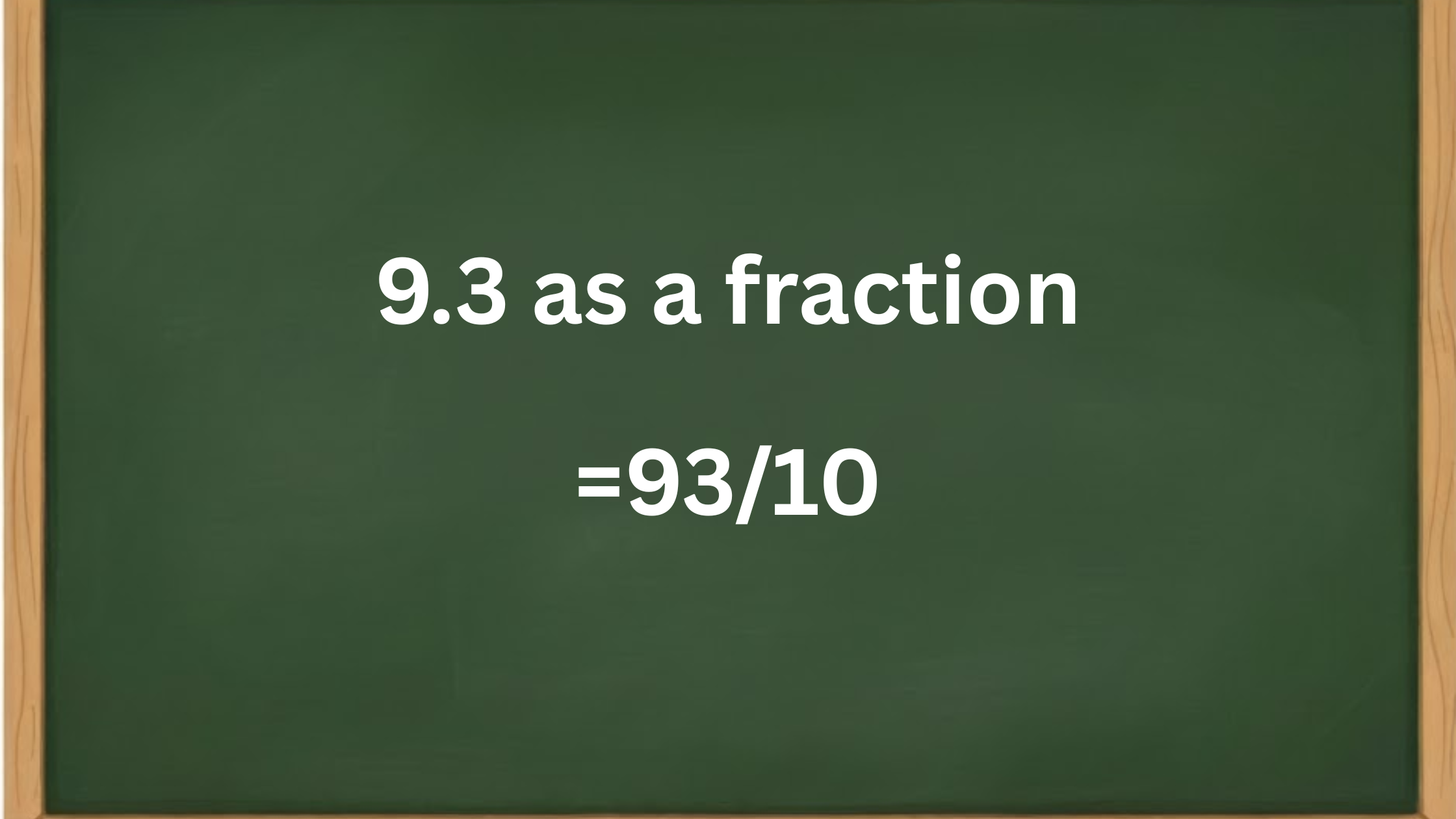
- Convert to an improper fraction: 9 × 10 + 3 = 93/10.
Now you know: 9.3 = 9 3/10 (mixed) = 93/10 (improper).
This method works for any decimal. Practice builds confidence.
Mixed Fractions vs Improper Fractions
Mixed fractions show a whole number plus a fraction: 9 3/10.
Improper fractions show everything as one fraction: 93/10.
Example: If you share 93 candies among 10 kids, each gets 9 full candies and 3 extra pieces.
Mixed fractions are easier to read. Improper fractions are better for calculations.
Knowing both forms improves cooking, measurements, and finances.
Real-Life Applications of 9.3 as a Fraction
Fractions appear everywhere:
- Cooking: 9.3 cups of flour = 9 3/10 cups.
- Travel: 9.3 kilometers = 9 3/10 km.
- Money: $9.30 = 9 dollars and 30 cents = 93/10 dollars.
- Education: Helps students understand decimals and ratios.
Fractions make numbers clear and practical.
Tips to Remember Decimal-to-Fraction Conversion
- Multiply decimals by 10, 100, or 1000 to remove the decimal.
- Combine with whole numbers for mixed fractions.
- Reduce fractions when possible.
- Use visual aids like objects or pie charts.
- Practice with decimals like 4.6, 7.8, or 0.25.
Simple repetition strengthens understanding.
Common Mistakes to Avoid
- Ignoring the whole number part.
- Forgetting to convert the decimal before combining.
- Reducing fractions incorrectly.
Example: 0.3 × 10 = 3. Add 9 → 9 3/10. Please keep it simple and accurate.
Connecting to a Global Audience
Fractions work the same worldwide. Recipes, measurements, and money calculations follow universal rules.
No matter your country, 9.3 as a fraction equals 93/10.
Teachers and parents can use these steps to teach students anywhere.
Emotional Engagement: Why Understanding Numbers Matters
Math can feel intimidating. Learning to convert decimals builds confidence.
Understanding 9.3 as a fraction reduces anxiety in real-life situations.
Small victories, like mastering 9.3, encourage curiosity and learning.
Advanced Tips for Learners
- Convert simple decimals to fractions mentally.
- Use fractions in budgeting, shopping, and cooking.
- Recognize patterns: 0.5 = 1/2, 0.25 = 1/4.
Small skills make math practical and enjoyable.
Creativity in Teaching Fractions
Use visual stories: pizza slices, chocolate bars, or cups of water.
Stories make learning memorable. Numbers alone are more complex to recall.
Challenge learners: “If 9.3 liters of juice serve 10 friends, how much does each get?”
Summary & Key Takeaways
- 9.3 as a fraction = 9 3/10 (mixed) or 93/10 (improper).
- Separate whole numbers and decimals to convert.
- Apply fractions in daily life: cooking, travel, money, and school.
- Visualization improves understanding.
Fractions make numbers tangible and valuable. Mastering them opens doors to practical skills.
Explore More
- How Many Tablespoons in a Cup: The Complete Kitchen Conversion Guide
- How Many Credit Hours Is Full Time: The Complete Guide for College Students
- Hcooh ch2 h2o: Complete Guide to Formula, Reactions, and Uses